
History of the Waitomo Caves
In December 1887 a local Maori chief and an English surveyor floated into the cave on a raft of flax stems, holding candles. The caves opened to visitors two years later, passed to the government in 1906, and were handed back to the descendants of the original owners in 1989. Your guide may be one of them, on any hobbiton and waitomo caves tour that goes into the show cave.
The dated entries below are being re-checked against the operator’s own record and may be revised. Everything practical about a visit today — times, inclusions, access, the camera rule — is current and lives on visiting the Waitomo Caves.
Before 1887
The caves were not discovered in 1887. Local Maori knew the entrances long before, and the name they carried says as much: wai, water, and tomo, the shaft or hole that water disappears into. What happened in 1887 was the first recorded exploration of the system from the inside.
The raft, the candle and the first descent
Chief Tāne Tinorau and the English surveyor Fred Mace went in together, on a raft made of flax stems, carrying candles. They entered from the stream and worked upstream into the dark. The glowworm ceiling was what they found.
It is worth pausing on what that took. Candlelight in a cave shows you a few metres of wall; the ceiling they were floating under was invisible until they stopped and let the flame die down.
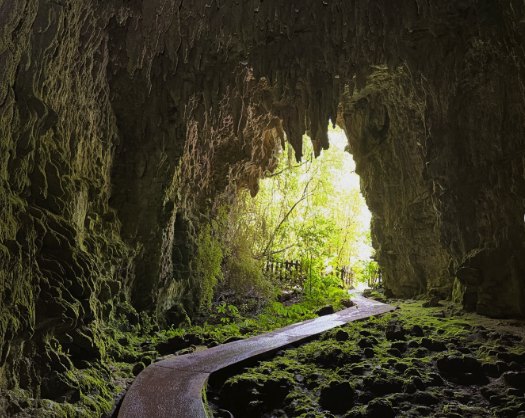
Open to visitors, 1889
Two years later the cave was open to visitors, with Tāne Tinorau and his wife Huti running the tours themselves. That makes it one of the oldest tourist attractions in New Zealand, and it has been operating on the same principle ever since: a guide, a boat, and a ceiling.
The government years, from 1906
Administration of the caves passed to the government in 1906. The family that had opened them lost control of the operation, and for most of the twentieth century the caves were run by the state.
The 1989 return
In 1989 the caves were returned to the descendants of the original Maori owners, and the operation has been run with their involvement since. It is the part of the story the tour itself carries: guides at the show cave may be descended from the man who first went in with a candle.
What Waitomo means
Wai is water. Tomo is a hole, a shaft, the place a stream drops out of sight. The name describes the landscape rather than the cave — the whole district is punctuated by them, and the photographs of a caver on a rope in the gallery are looking down one.
Who runs the caves now
The show cave, Ruakuri and Aranui are operated from a single visitor centre at 39 Waitomo Village Road. The cave tour booked through these pages is run by the Waitomo Caves Group, and it is the same 45-minute walk and boat ride whether you buy it alone or inside a day trip from Auckland.
The chronology
| When | What happened |
|---|---|
| Before 1887 | The entrances are known locally; the name records what the water does here |
| December 1887 | Tāne Tinorau and Fred Mace enter by flax raft and candlelight |
| 1889 | The cave opens to visitors, guided by Tāne Tinorau and Huti |
| 1906 | Administration passes to the government |
| 1989 | The caves are returned to the descendants of the original owners |
| Today | Three show caves run from one visitor centre, open 9am to 5pm daily, on timed departures |
Dated entries here are being re-checked against the operator’s own record and may be revised; the present-day rows come from current listings.
Walk in where they did
The 45-minute guided tour follows the stream they rafted up, and finishes on the water under the same ceiling.
Visiting in the early days
The early tours were candlelit and the boat was worked by hand along a wire, which is still how the boat moves through the Grotto today. Almost nothing about the mechanics of the visit has changed in more than a century; what has changed is the lighting in the dry chambers and the number of people the cave takes in a day.
The one rule that has hardened is the camera ban. Early visitors photographed what they could by magnesium flash; today nothing electronic comes in at all, for reasons set out on the glowworms.
Read next: the three show caves compared · the animal on the ceiling · planning a visit today · Waitomo Caves Tours for every tour.